


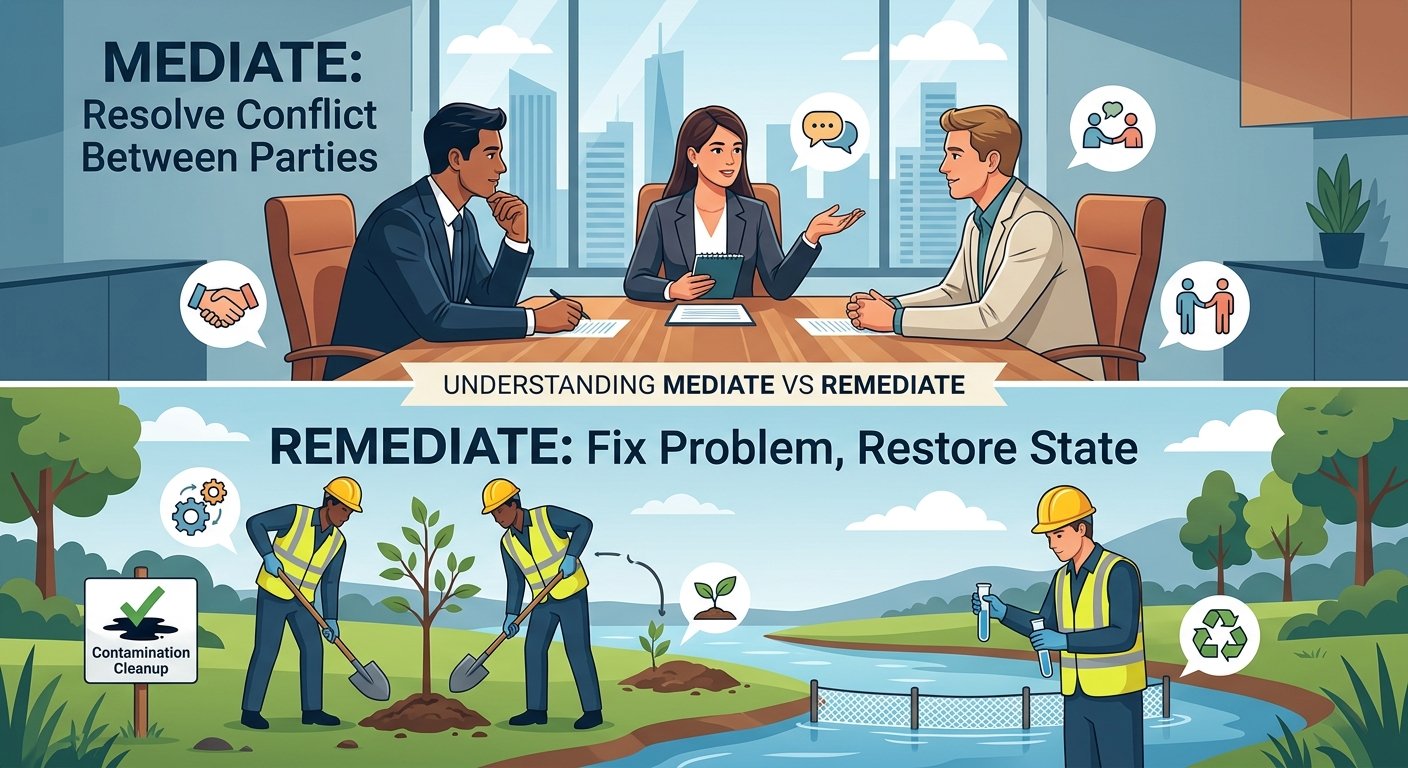
The formal businesslike tone and the similar root of the words often lead many writers to mix up the words mediate vs remediate. But it’s important to note that these two terms have different applications, and using them interchangeably can cause confusion for readers or diminish the quality of your professional writing. Whether you’re in the legal field, education, cybersecurity or just regular communication, understanding mediate vs. remediate matters is crucial. We will explain the meaning of each word, provide some practical examples, and suggest some easy ways to memorize which word is the correct one for you.
Table of Contents
What do you mean by “mediate”?
In the context of mediation, the term “mediate” refers to the process of assisting two or more parties in a disagreement or conflict to reach a resolution. In mediation, you place yourself between two opposing parties and try to facilitate impartial action to help you achieve an equitable settlement. In addition, mediation can include a neutral third party who is able to listen carefully and make fair suggestions. So, the first step towards understanding the difference between mediate vs remediate is to grasp the fact that mediation is about communication and conflict resolution.
Create common contexts for mediate
The word ‘mediate’ is generally used when speaking about legal, professional or interpersonal contexts. For instance, divorce mediators are used to help couples reach a custody agreement without having to engage in a lengthy trial process. In the same way, a mediator at the workplace intervenes when there are recurring conflicts between employees that impact team productivity. Professional mediators often are trained to have patience and neutrality in mediation before becoming mediators of sensitive disputes.
What is the meaning of Remediation?
But “remediate” has a very different meaning; it’s used to mend, correct or enhance something that has been amiss. Remediation is not a resolution of a dispute between persons as with mediation. Rather, it is concerned with fixing up the damage, filling in the deficiencies, or returning it to an acceptable state. However, a comparison of mediate and remediate shows that they are in different conceptual domains despite the fact that they sound alike.
Common Contexts for Remediate
“remediate” is a word often used by environmental scientists when talking about polluted land or contaminated water sources. For example, a business may clean up after an oil spill has affected the environment in the vicinity. Meanwhile, teachers refer to this term when they talk about programmes that help pupils catch up with their peers. Further, cybersecurity practitioners rectify vulnerabilities once they are identified in a company’s digital system.
Key differences between Mediate and Remediate at a Glance
These two words look alike, and a comparison sometimes makes things more clear than lengthy explanations. The table below shows a few key differences between mediate and remediate.
| Category | Mediate | Remediate |
| Core Meaning | Resolve a conflict between parties | Fix or correct a problem |
| Subjects Usually Appearing | People in disagreement | Damage, errors, or deficiencies |
| Common Fields | Law, workplace issues, family issues | Environmental, educational, or cybersecurity issues |
| Third Party Involved | Yes, typically a neutral mediator | Not always required |
| Example Sentence | The legal representative assisted in the contract dispute, which was resolved through mediation. | The team made efforts to rectify the security issue. |
| Word Origin | From Latin “mediare,” meaning “to be in the middle.” | From Latin “remediare,” meaning “to heal ag |
Mediate vs remediate are very different in their meaning and in how they are used. Therefore, if you have these in mind, you will know almost immediately which word to select!
Some people are confused between mediate and remediate
With the similarity of spelling and the fact that the words have the same Latin etymology, it is easy to confuse mediate vs remediate without taking the time to know that they have such different meanings. The two terms are derived from the Latin roots, and they both have the word ‘midi’ or ‘medic’ as part of the word, which makes it even more confusing. Once you get your heads around the emphasis is on people with mediation and on problems with remediation it becomes much more obvious.
What’s more, autocorrect features can exacerbate the mixed-up situation by offering the incorrect word when the spelling is similar. So, it’s important to proofread your work carefully whenever you’re using either of these words in your professional or academic writing.
Mediate vs Remediate: Grammar and Word Forms
The knowledge of word forms can also serve to make sense of the word mediate vs remediate in everyday writing. The verb form of mediate is the same, as is the related noun form (mediation) and a person who does this (mediator). In the same way, “remediate” is a verb, while “remediation” is a noun, but there is no comparable term to “mediator” for this second verb.
Verb Tenses and Usage Patterns
Both words are regular verbs in English. Mediates, mediated, and mediating would be the correct forms for mediate. Similarly, the verb remediate becomes “remediates,” “remediated,” and “remediating” in different types of sentences. The base meaning of both verbs is predictable and there is little confusion in using them when you understand the base meaning.
Real-World examples of Mediate vs Remediate
Using mediate vs remediate in realistic sentences often helps to help the distinction. Think of a situation in a business where two departments are in a conflict over the allocation of the budget. In such a case, the manager could act as a neutral mediator and help the two groups have an open discussion so they can resolve their disagreement.
So, let’s now take a look at a different situation with an old software system in a company. The IT department would not be involved in any mediation, but instead would be responsible for remediating the detected security holes if detected as part of a regular audit. The difference between mediate and remediate is well illustrated in these two examples, which may seem similar at a glance but are really not the same.
Legal Field Examples
Attorneys will often facilitate negotiations that resolve conflicts BEFORE the client decides to go into costly litigation. A family attorney may, for instance, help settle a contentious custody battle and assist both parents to settle on a viable custody schedule. At times, the contractual problems are identified after a contract has been executed and need to be addressed by legal teams. Hence, the two terms are used often in the law but have entirely different meanings.
Environmental and Technical Examples
There are many cases of plans being discussed at an environmental agency before construction that needs to take place on a contaminated industrial site. Furthermore, the cybersecurity team rectifies software flaws as soon as possible after they find ways for hackers to enter. As these technical examples demonstrate, remediation always involves solving a real issue that is concrete, not dealing with an interpersonal conflict.
Mediate and Remediate are spelt the same way but mean entirely different things
Choosing between mediate vs remediate will be easy during everyday writing with the help of memory tricks. First, notice that the word “mediate” includes the word “media” which is a reference to “two sides.” Second, keep in mind the word “remediate” contains the prefix “re” which is commonly used to indicate a restoration or fixing up to a previous state.
Also, when you link “mediate” with mediators and “remediate” with repair and correction, there’s a mental shortcut that will be remembered over time. Most writers find that these associations are easier to memorize than abstract grammar rules, because they are based on familiar concepts.
Know the difference between the words “mediate” and “remediate” in professional writing
In formal documents, these words must be chosen wisely, because they can affect the credibility of the professional writer if the correct word is not used. For example, in a report about conflict resolution, “mediate” should be used, and in a report about infrastructure repairs, “remediate” should be used. So, it is particularly relevant to the professionals in the legal, human resources, environmental science and technology fields to understand the difference between mediate and remediate.
Additionally, editors and proofreaders should be mindful of these terms in the reviewing process as spellcheck programs may not be able to detect the wrong use of these terms. To avoid embarrassing mistakes in publications or materials presented to clients, then it is important to develop the habit of checking word choice.
Sometimes words have several meanings
Sometimes, thinking of synonyms provides an easier way to distinguish mediate vs remediate during writing or editing. The terms “arbitrate,” “negotiate,” and “intervene” are closely related to mediation, as they all are forms of reaching a resolution between two or more parties. Words such as repair, correct, restore, etc., are similar to remediation, as they focus on rectifying a problem with a tangible object as opposed to resolving a dispute.
These synonym lists can also be used as a mental reference to make sure you’ve selected the right word before completing any sentence. Also, it is particularly effective for non-native English speakers who struggle with unfamiliar word meanings.
Common Pitfalls!
A common error is to use “remediate” when talking about a conflict you are personally involved in, which really means you are describing a conflict that you are trying to fix. For instance, the term “remediate an argument” is unnatural, as arguments need to be mediated, not “repaired. In a similar way, the term “mediate” in the context of broken equipment is ambiguous because they are problems with the equipment, and remediation is the appropriate term.
With these frequent mistakes in mind, it’s important to review sentence structure carefully before publishing content. So, pausing to consider if your sentence has a person solving a conflict or a problem being addressed can immediately tell you which one of the words is the best fit.
Industry-Specific Usage Patterns
Each industry will use one term more or less, depending on what they do on a daily basis. When talking about resolving conflict in the workplace, legal and HR professionals often use the terms “mediate” and “mediation.“Mediation” and “mediate” are terms that legal and HR professionals are often used in relation to resolving conflict in the workplace. In the meantime, the term “remediation” is becoming increasingly common in the fields of environmental science, education and cybersecurity when talking about corrective action plans.
If you know about these industry trends, you will be able to predict which word will be used more frequently in certain business documents. Therefore, the identification of this pattern is also an aid to writers in selecting words when they write industry-related reports or presentations.
The origins of the two words goes back to ancient times
Another way to delve into word history is to write about it. The word ‘mediate’ originated from the Latin ‘mediare’ meaning to be in the middle between two points. Mediation has a long history in many cultures and traditions, as the use of neutral individuals who act as intermediaries between conflicting parties has been a practice since ancient times.
In the meantime, remediate” comes from the Latin word “remediare,” which is very close in meaning to the word heal or cure. In historically common use, this word was used in medical settings, in reference to treatments designed to restore health after disease or injury. As time passed, the term remediation grew to include not only medical problems, but also damage to the environment or technical problems, as well as educational failures. It is therefore not surprising to find that mediate vs remediate began to acquire two rather different meanings, given that they have a similar etymological history.
How to decipher words using context clues
In a sentence, context clues will sometimes tell you instantly which word to use when you are writing. Mediation almost always fits when your story has two parties who disagree on an issue, needs to go through a negotiation process, or has a neutral facilitator. Whereas if your sentence refers to damage, an error, contamination, or a bug that needs fixing, then remediation is the obvious solution instead.
Also, if you pay attention to the neighboring nouns, you will understand your word choice at once. Sentences that reference “dispute” or “disagreement” generally go with “mediation” and sentences that reference “damage” or “vulnerability” go with “remediation.” Therefore, the context clues are noticeable and after a while, it becomes easy to tell the difference between mediate and remediate.
Academic and Educational Perspectives
Both terms are sometimes used in educational contexts, but are quite different for students and administrators. In some schools, the school’s trained counsellor will be used to help resolve conflicts between pupils who are involved in such bullying or interpersonal conflict in a constructive manner. In contrast, the schools discussed remediation programs that are implemented to help students when they are not meeting grade-level standards far more often.
This distinction is important to know when thinking about remediation programs, as it can help to facilitate the effective communication of student needs between parents and educators, since remediation is not about conflict resolution and is more about filling learning gaps. In addition, understanding this distinction avoids misunderstandings between school and families when planning for school. Thus, as with other professions, a discussion of mediate versus remediate in educational settings bolsters the overall trend.
The application of technology and cyber security
The term “remediate” is widely used in modern technology fields in talking about actions taken in response to a security threat or software malfunction. After spotting suspicious activity in a company’s network infrastructure, cybersecurity analysts typically rush to the rescue to fix the vulnerabilities. Also, IT departments monitor the amount of time that it takes to fix issues after they have been identified, tracking the time it takes to remediate issues after initial identification.
Interestingly, no mediation seems to be mentioned in purely technical documentation, because a neutral third party cannot be used in a situation where there is an interpersonal disagreement, but there is a computer system. But, in cases of workplace conflicts that stem from technology disputes, such as whether projects belong to humans or technology, human mediation may be necessary in addition to the technology remediation. This overlap shows how mediate vs remediate can sometimes seem to occur in the same larger workplace context, but to deal with entirely different aspects of the same context.
Final Thoughts on Mediate vs Remediate
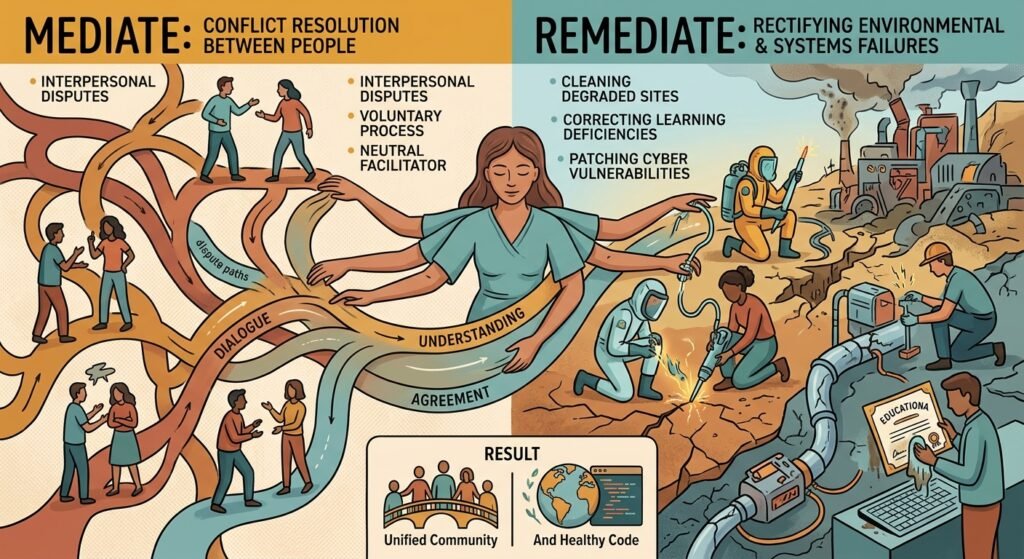
Ultimately, mastering the distinction between mediate vs remediate comes down to remembering their core purposes within a sentence. Mediation always involves resolving disagreements between people, while remediation always involves correcting problems, damage, or deficiencies. Once you internalize this fundamental difference, choosing the correct word becomes second nature rather than a constant source of confusion. Whether you work in law, education, environmental science, or everyday communication, keeping these definitions clear will strengthen your overall writing precision.
Frequently Asked Questions FAQs
Q1: What is the simplest way to remember mediate vs remediate?
Remember that mediation resolves conflicts between people, while remediation fixes problems, damage, or technical deficiencies instead.
Q2: Can mediate and remediate ever be used interchangeably?
No, these words describe entirely different actions and should never be substituted for one another in writing.
Q3: Is remediate always related to environmental issues?
No, remediation also applies to education, cybersecurity, and other fields requiring correction of problems or deficiencies.
Q4: What is the noun form of mediate?
The noun form of mediate is “mediation,” while a person performing this role is called a “mediator.”
Q5: What is the noun form of remediate?
The noun form of remediate is “remediation,” commonly used across environmental, educational, and technical writing contexts.
Q6: Why do people often confuse these two words?
Both words share similar spelling and Latin roots, which naturally leads to confusion despite their different meanings.
Q7: Which word should I use when describing conflict resolution?
Always use “mediate” when describing efforts to resolve disagreements or disputes between two or more parties.


