


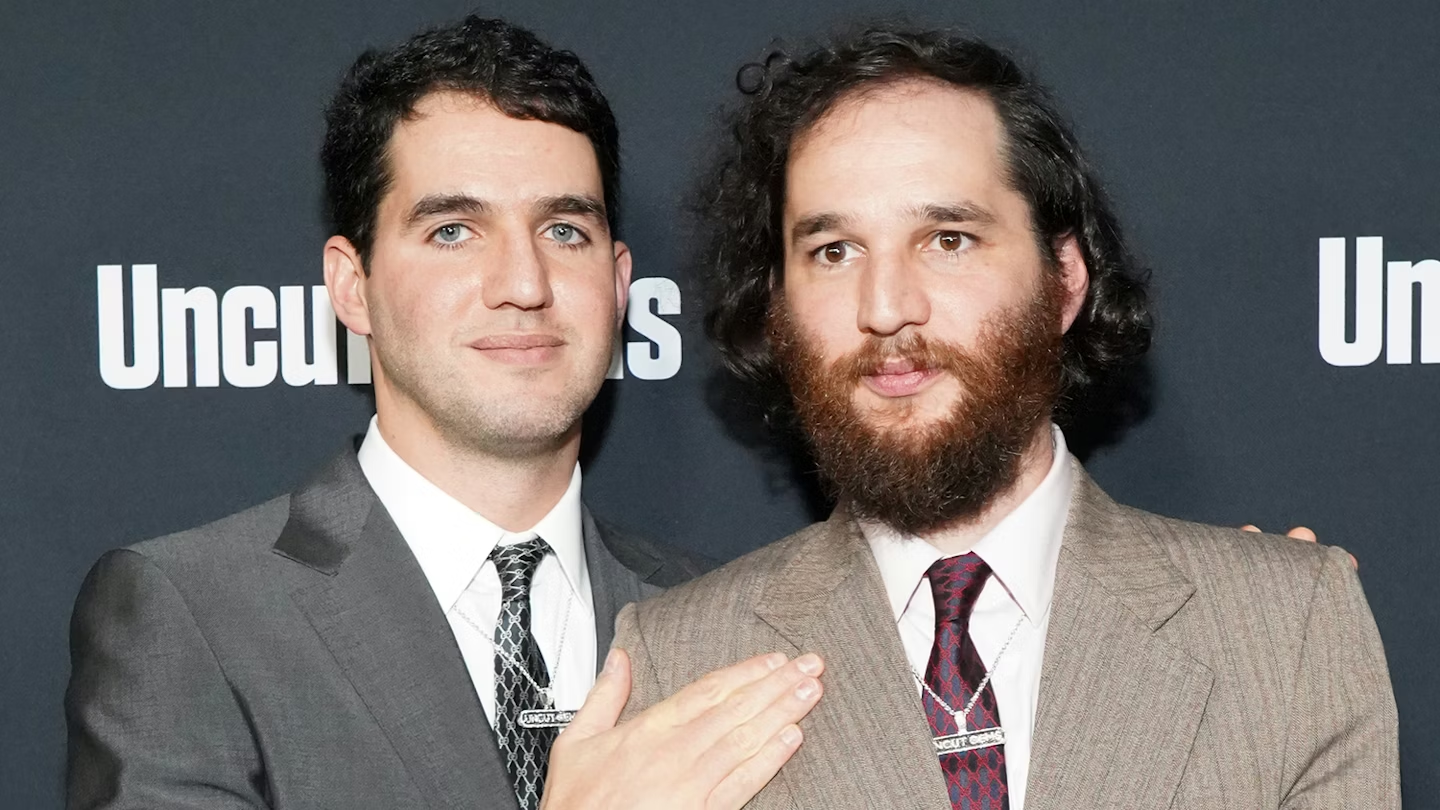
Josh Safdie’s films don’t begin so much as they erupt. A camera lunges forward, breathless; voices overlap; streets glare with fluorescent impatience. Time feels borrowed. Fate feels rigged. From the first frames, you sense that whatever world you’ve stepped into will not wait for you to catch up. That sensation—panic as aesthetic, anxiety as narrative engine—has become Josh Safdie’s signature, and it has quietly reshaped what contemporary American cinema dares to feel like.
Origins in Motion: Growing Up Inside the Noise
Josh Safdie was born in New York City, a place that does not whisper its lessons. The city’s density—human, linguistic, emotional—became less a backdrop than a collaborator. He and his younger brother, Benny, grew up absorbing the rhythms of sidewalks, the minor tragedies of missed trains, the negotiations happening at every bodega counter. This wasn’t nostalgia; it was immersion. Long before film school or festival premieres, the Safdies were learning how chaos organizes itself.
Josh’s early exposure to cinema was inseparable from family and environment. Movies were not sacred objects; they were tools—ways of watching people, of noticing how desperation can turn ordinary gestures into drama. That sensibility later crystallized at Boston University, where Josh studied film, but the education that mattered most remained informal and ongoing: New York as classroom, street as soundstage. The city itself—its urgency, its relentlessness—would remain inseparable from his work, a relationship as intimate as it is volatile. (josh safdie)
Brotherhood as Method: The Safdie Dynamic
To talk about Josh Safdie without mentioning his brother is to misunderstand the project. Though each has distinct instincts, their collaboration functions less like a division of labor and more like a shared nervous system. Josh often gravitates toward performance, character psychology, and raw emotional texture, while Benny brings structural discipline and editorial sharpness. Together, they chase something neither could fully articulate alone.
Their breakthrough arrived not through polish but through insistence. Early films like The Pleasure of Being Robbed and Daddy Longlegs established a grammar: handheld cameras, nonprofessional actors, stories that feel overheard rather than scripted. These were not movies asking for approval; they were demanding attention.
That ethos culminated in Good Time (2017), a film that transformed Robert Pattinson into a neon-lit avatar of moral exhaustion. While the movie announced the Safdies to a wider audience, it also clarified Josh’s particular obsession: what happens when love—especially familial love—becomes indistinguishable from harm.
Anxiety as Aesthetic: The Evolution of a Style
By the time Uncut Gems arrived in 2019, Josh Safdie’s cinema had become a pressure chamber. The film’s protagonist, Howard Ratner, is not merely stressed; he is addicted to stress, to the chemical high of risk itself. Watching the film feels less like observing a character arc than enduring a prolonged nervous episode.
What makes Uncut Gems remarkable is not its volume but its precision. Every shout, every overlapping conversation, every disorienting cut is calibrated to keep the viewer inside Howard’s head. Josh Safdie has spoken about wanting audiences to feel trapped—not metaphorically, but physically—by the movie’s momentum. It’s cinema as sensory assault, yet never careless. Chaos here is designed.
( josh safdie)
This evolution reflects a broader shift in American independent film, where emotional realism no longer means quietness. Josh Safdie rejects the idea that seriousness must be restrained. His work insists that modern life—especially urban life—is experienced at an unbearable pitch, and that art should not lie about that.
Cultural Meaning: Why Josh Safdie Feels So Now
Josh Safdie’s relevance is not accidental. His films speak directly to a generation fluent in overstimulation. Smartphones buzz. Markets fluctuate. Social identities are negotiated in public. The Safdie universe mirrors a world where attention is fragmented and decisions are made under pressure, often with incomplete information.
There’s also something deeply ethical in Josh’s approach. He does not condescend to his characters, no matter how reckless they become. Howard Ratner is not a moral lesson; he is a human being whose flaws are inseparable from his dreams. That refusal to simplify resonates in a cultural moment suspicious of easy villains and heroes.
Film scholars have noted how the Safdies’ work aligns with a tradition of American cinéma vérité while updating it for a hyper-mediated age. The British Film Institute has described their style as “street-level operatic,” a phrase that captures the tension between realism and excess that defines Josh Safdie’s cinema ( josh safdie).
Environment as Character: Cities That Don’t Blink
Josh Safdie’s films are inseparable from place. New York isn’t photographed; it’s endured. Jewelry districts hum with transactional menace. Nightclubs pulse like cardiac monitors. Apartments feel temporary, as if the walls themselves expect eviction.
This attention to environment goes beyond authenticity. It’s about moral geography—how spaces pressure behavior. In Josh Safdie’s world, cramped interiors amplify bad decisions, while open streets offer no relief. Freedom exists only in motion, and even then, it’s provisional.
Influence and Legacy in Real Time
Though still early in his career, Josh Safdie’s influence is already visible. A wave of filmmakers has embraced heightened sound design, improvisational dialogue, and morally ambiguous protagonists who don’t seek redemption. Streaming platforms, once hostile to abrasive pacing, now chase it.
The Criterion Collection’s critical essays situate the Safdies within a lineage that includes John Cassavetes and early Martin Scorsese—directors who treated discomfort as a form of truth rather than a flaw ( josh safdie). Yet Josh Safdie’s contribution feels distinctly contemporary, shaped by an era where anxiety is not episodic but ambient.
FAQs
What is Josh Safdie best known for?
He is best known for co-directing Good Time and Uncut Gems, films celebrated for their intense pacing and psychological immersion.
Does Josh Safdie always work with his brother Benny?
While most major projects are collaborations, Josh has individual interests, particularly in performance-driven storytelling and acting.
Why are Josh Safdie’s films so stressful to watch?
The stress is intentional. His films use sound, editing, and narrative compression to replicate the emotional experience of living under constant pressure.
Are Josh Safdie’s films improvisational?
They often incorporate improvisation, especially in dialogue, but within tightly controlled narrative structures.
What filmmakers influence Josh Safdie?
Influences include John Cassavetes, early Scorsese, and documentary-style American independent cinema.
Conclusion: Living Inside the Rush
Josh Safdie’s cinema does not ask for comfort. It asks for surrender—to velocity, to uncertainty, to the idea that meaning often emerges only after endurance. His films mirror a world where stability is a rumor and intensity is the default setting, yet they also insist on empathy within that storm.
Read more: Deion Sanders Jr: Life, Career, and Rise as Media Entrepreneur