


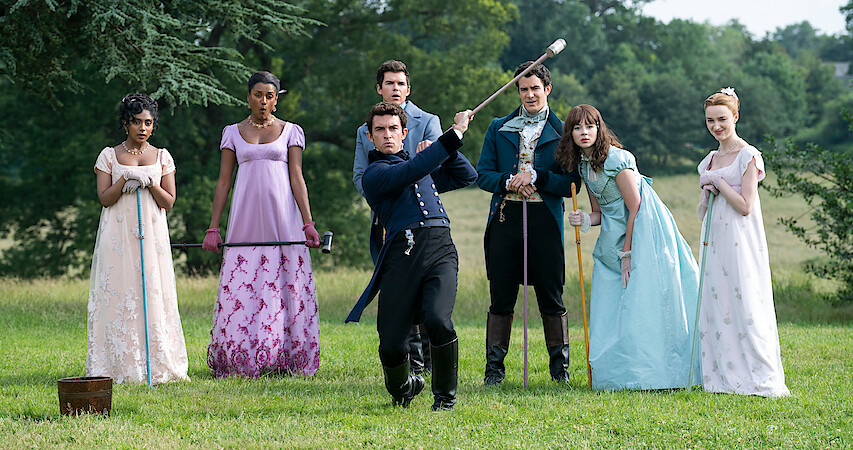
Bridgerton Season 2 opens not with a kiss, but with a restraint so taut it hums. The ballroom still glitters, the violins still sigh, but something has shifted in the air—an ache, a hesitation, a sense that romance is no longer merely about surrender, but about choice. London’s Regency streets glow as they always have, yet beneath the silk and candlelight, the series has grown sharper, older, more self-aware.
The Inheritance of a Phenomenon
When Bridgerton first arrived on Netflix in 2020, adapted from Julia Quinn’s bestselling novels (bridgerton season 2) and shepherded by Shonda Rhimes’ Shondaland (bridgerton season 2), it felt like a cultural dare: could a lavish period drama be unapologetically modern, racially reimagined, and emotionally populist? Season 1 answered with a resounding yes, becoming one of Netflix’s most-watched series (bridgerton season 2).
Season 2 inherits that success but refuses to coast on it. Based primarily on The Viscount Who Loved Me (bridgerton season 2), the narrative pivots from Daphne’s romantic awakening to Anthony Bridgerton’s internal reckoning. The shift matters. Where Season 1 luxuriated in discovery, Season 2 interrogates responsibility.
Love as a Battleground
Anthony Bridgerton, played with tightly wound intensity by Jonathan Bailey (Jonathan Bailey), is no longer the rakish observer. He is the viscount now, bound by lineage, patriarchy, and the expectations of Regency masculinity (Regency period). His courtship of Edwina Sharma seems practical—strategic even—until Kate Sharma enters the frame.
Kate, portrayed by Simone Ashley (Simone Ashley), is not written as an obstacle but as a mirror. Their connection is built less on dialogue than on silence: glances held too long, breaths caught mid-sentence. The show borrows the grammar of classic romantic tension—think Pride and Prejudice (Pride and Prejudice) retools it for an era more attuned to consent, agency, and emotional labor.
A Regency World Reimagined
The world of Bridgerton Season 2 remains defiantly anachronistic. String quartets transform pop songs into courtly anthems (bridgerton season 2), costumes shimmer with colors rarely associated with historical accuracy (bridgerton season 2), and the social season unfolds like a high-stakes reality show. Yet this is not historical negligence—it is historical argument.
By casting actors of South Asian descent as the Sharmas and weaving in subtle references to colonial history, the series gestures toward the British Empire’s global entanglements (bridgerton season 2). It doesn’t offer a thesis, but it opens a door, suggesting that romance itself has always been political.
Fandom, Fashion, and Feeling
To watch Bridgerton Season 2 is rarely a solitary act. Online fandoms on platforms like Reddit (Bridgerton Netflix) and TikTok (bridgerton season 2) dissect every glance, while fashion houses mine its silhouettes for corseted inspiration (bridgerton season 2). The show has become lifestyle-adjacent: a mood, a palette, a fantasy of heightened feeling in an era numbed by screens.
| Element | Season 1 | Season 2 |
|---|---|---|
| Central Theme | Discovery & desire | Duty vs. selfhood |
| Romantic Tone | Explicit, sensual | Restrained, simmering |
| Cultural Focus | Social debut | Power and responsibility |
A Conversation in the Quiet
In a quiet London café not far from a Georgian square, a television critic and cultural historian, Dr. Amelia Grant, reflected on the season’s resonance.
Q: Why does Season 2 feel different?
A: “It treats love as labor. Not just passion, but the work of unlearning inherited roles.”
Q: Is that why audiences responded so intensely?
A: “Yes. It mirrors modern relationships—especially for women—where desire often clashes with expectation.”
Q: Does the period setting limit that message?
A: “Paradoxically, it amplifies it. Distance makes truth clearer.”
Q: Will this version of romance endure?
A: “Only if future seasons keep asking uncomfortable questions.”
Why It Lingers
Bridgerton Season 2 matters because it resists easy catharsis. It understands that love, like society, evolves through tension. In an age of instant gratification, it dares to slow down, to let yearning stretch until it becomes revelation.
Read more: Katy Perry and Justin Trudeau: The Surprising Connection You Didn’t Know