


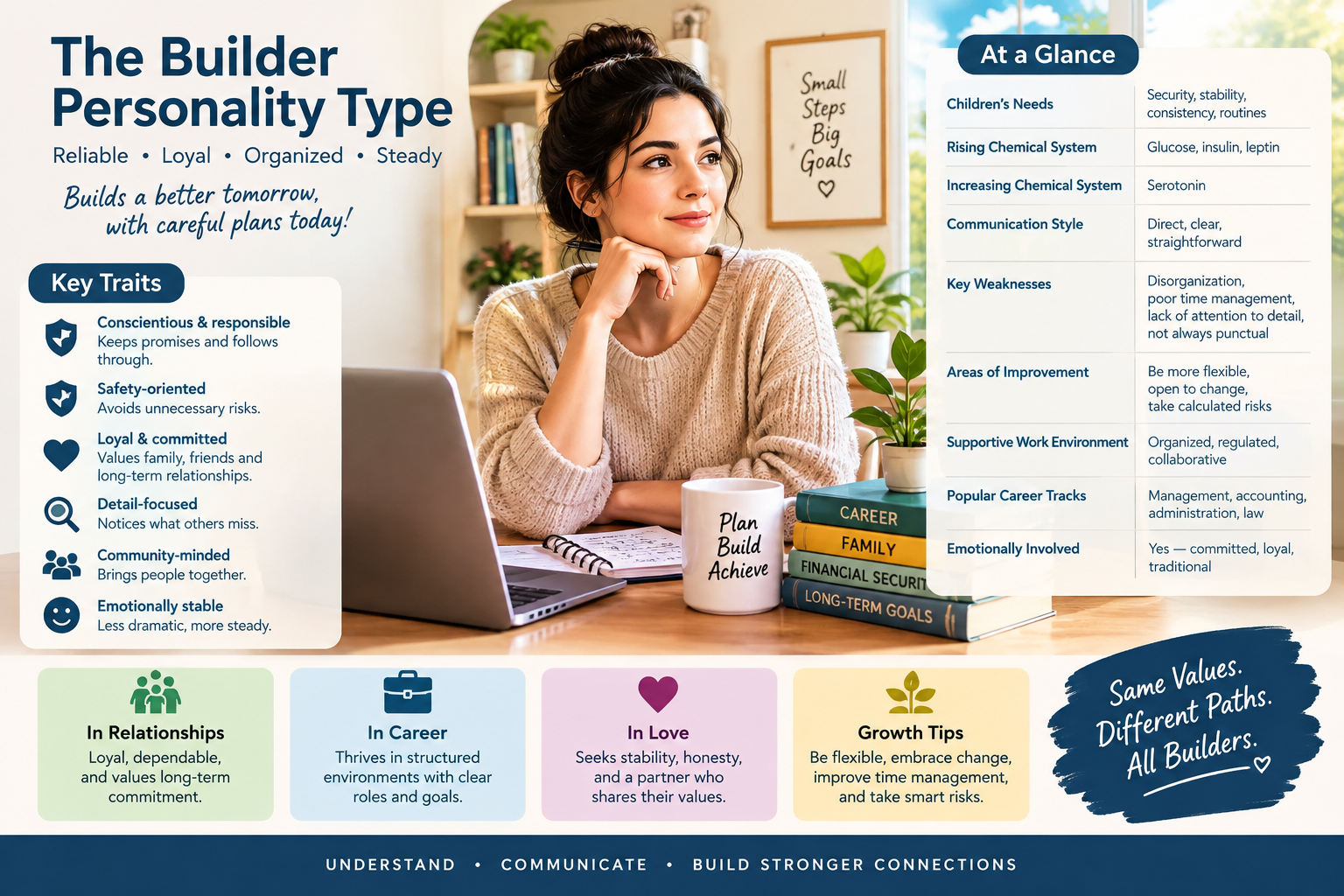
Ever met an individual who is so meticulous in planning that he or she never breaks a promise? This is probably the personality of the builder. This temperament is one of four basic personality types that biological anthropologist Helen Fisher popularized and that influence how the individual thinks, loves and works. Thus, knowing this temperament will assist in the ability to comprehend how some people crave structure while other individuals are more drawn to spontaneity.
Everything from essential characteristics to career options and dating compatibility is explained in this guide. Common misconceptions, growth strategies and how this temperament is similar and different to the other three Fisher identified will also be discussed. Whatever you’re looking into, whether you are looking into yourself or someone you love, you will leave with a greater understanding of the builder personality type.
Table of Contents
What Is the Builder Personality Type?
The Fisher study found that the personality type of the builder is largely the result of serotonin activity in the chemical systems of the brain. Individuals with this temperament are usually conservative, loyal, and prefer the known over the new. Builders like stability, routine and thoughtful choices, whereas Explorers like risk. Moreover, this temperament is more community-oriented, family-oriented and socially oriented than others. These people are typically the most effective glue that keeps organizations, families and communities together in a reliable and stable manner.
Hence, it is essential to understand the builder personality type, either in yourself or in others, to enhance your communication and collaboration. In Fisher’s larger model there are Explorers, Directors and Negotiators, all defined by distinct patterns of brain chemistry and behavior.
What is the Builder personality type?
When researchers examine the builder personality type in various populations, they consistently find the following characteristics. In the first place, Builders are incredibly conscientious, meaning that they are people who stick to their commitments without prompting. Second, they are very safety oriented, and will not take risks they do not require, as that may endanger their finances or emotional state. Thirdly, this is a temperament that is always loyal to friends, family and long-term romantic partners. Also, they are likely to have a strong ability to think in detail and see very minute discrepancies others might not even pay attention to.
In the meantime, Builders are more likely to take the rules, hierarchies and traditional institutions for granted than experimental or unconventional. As a result, the builder personality type has a reputation for being reliable, honest, and consistently the same in different circumstances. The emotional stability completes the picture, as Builders tend not to be as dramatic as more impulsive temperaments.
The Builder Personality Type at a Glance
When the characteristics of the builder personality type can be clearly listed, it’s easier to understand. This is a helpful reference chart for some characteristics, strengths, and potential issues.
| Category | Description |
| Children’s Needs | Children require security, stability, consistency, and predictable routines. |
| Rising Chemical System | Glucose, insulin, and leptin. |
| Increasing Chemical System | Serotonin. |
| Communication Style | Direct, clear, and straightforward. |
| Key Weaknesses | Disorganization, poor time management, lack of attention to detail, and lack of punctuality. |
| Areas of Potential Improvement | Reduce rigidity, become more open to change, and take more calculated risks. |
| Supportive Work Environment | Regulated, organized, and collaborative. |
| Popular Career Tracks | Management, accounting, administration, and law. |
| Emotionally Involved | Yes — committed, loyal, and traditional. |
As seen in the table, the builder personality type are best served when they can have structure and predictability easily accessible. This love of stability often, however, means that it is not the most flexible in rapidly changing situations. It is important to understand both sides to take advantage of strengths and to be aware of areas that need improvement and work on them.
The Builder is a personality type characterized by several strengths
Each temperament has its unique strengths and the builder temperament has more than a few to celebrate. One of their many strong points is their reliability as Builders are not one to back out when they commit. Also, organizational skills are clearly evident in these people since they are naturally system builders, as this is why projects stay on track. Further, this temperament is very patient and can perform repetitive tasks without facing a lack of motivation rapidly. Loyalty is also a hallmark of their strength, especially in friendships, marriages, or years-long professional associations.
In addition, Builders are very good at keeping traditions alive and ensuring the continuum of family traditions and organizational cultures across generations. Their decision making is also practical and useful, as they consider the risks before taking big decisions in life. Their financial discipline complements their other strengths; Builders are likely to make careful choices in their budgeting and will not make any hasty decisions about spending.
To identify common weaknesses and growth areas
However, no personality type is flawless and the builder personality type is no exception, and they do have real problems to confront and be honest about. Change can be resisted, leading to conflict, particularly when there is a rapid transformation in the workplace, especially at the level of technology or structure. Builders can sometimes be hesitant adopting new techniques in a timely manner because they are not used to working with new methods and techniques that have not been proven and tested.
Also, this temperament may be inflexible to an coworkers or peers who prefer to be spontaneous, imaginative, or unconventional in ways of solving problems. In general, it’s good to be risk averse, but sometimes Builders are not willing to take calculated risks on opportunities that are worthwhile. Furthermore, they tend to be very attached to rules, which might lead to conflicts with more flexible personalities who are accustomed to bending rules. Sometimes, perfection can intrude; Builders may set themselves an unnecessarily high standard of consistency. Fortunately, the personality type of builder can become more flexible as a result of deliberate practice and a gradual exposure to controlled uncertainty.
At what age does the Builder compare with other temperaments?
The context of the situation is very important, so if one compares the builder personality type with Fisher’s other three personality types, one will better understand its distinctiveness. Explorers are motivated by novelty, spontaneity and risk, mainly because they are addicted to the sensation of being new, spontaneous and risky, which is triggered by the release of dopamine.Explorers are driven by novelty, spontaneity, and risk, far less willingly than Builders are. Directors, who are generally testosterone driven, are very logical, competitive and goal oriented. Estrogen and oxytocin drive negotiators to focus on empathy, intuition and speaking rather than structure.
Builders are unique in focusing on stability, community, and loyalty, not novelty, competition, or nuance. This difference is not a weakness or superiority of one of the three temperaments; each of them has its own values in different circumstances. When two temperaments complement one another in the workplace and in relationships they are the most effective in reaching a balance of the natural tendencies and blind spots of each. It is important for Builders to acknowledge these differences, as it can help them accept that colleagues or partners may be reacting to similar situations differently.
There are several misconceptions about the Builder personality type
There are a number of common misconceptions about the “builder” personality type that can be clarified to promote better understanding. A popular fallacy is that Builders are not creative at all, which fails to acknowledge a more complex truth. Builders are known for their creativity despite not being a free-form artist, but rather a person who works with defined tools such as architecture, engineering, or craftsmanship in the context of more detailed work.
The other myth is that Builders do not like change – in reality the exact opposite is true, they prefer small well-thought-out changes rather than sudden upheavals. Also, it is often argued that this personality type is psychologically shallow, but Builders tend to be emotionally deep, but they are not as emotionally expressive. Acknowledging these misunderstandings helps to avoid unfair stereotyping and promotes fair and respectful judgment of Builder colleagues and partners.
Builder Career Paths are job positions that align well with their personality profile.
The right career is very important and the builder personality type tends to gravitate towards certain lines of work. Because these require dependable leadership skills, consistency and organizational ability, Builders excel in management roles. There is also a high number of Builders in accounting and finance, since accounting and finance are rule-based and detail oriented fields. Legal professions are also considered to be suitable because they require precision, structure and respect for precedent. Another natural application is in administrative positions in larger organizations, where Builders can ensure that things run smoothly and efficiently.
Also, the government tends to hire this type of person, as they value order, structure and institutional continuity. Healthcare administration and logistics management are also very attractive options, as both are heavily reliant on planning and process consistency. The builder type of personality is best suited to an environment that provides structure and consistency over improvisation.
Best Work Environments for Builders
In addition to particular jobs, the workplace environment is important for Builders’ satisfaction with their work life. Organizations that are structured and have clear hierarchies are better for the builder personality type than chaotic and fast-paced start-ups. Predictable schedules also are important, as Builders work best and are more efficient when they know what to expect daily. Team settings are also fine as long as the teams have clear roles and procedures.
Careers to be approached with caution.
The builder personality type may be more likely to find these careers challenging than others, especially those in unpredictable and volatile career fields. If entrepreneurship is not a possibility, it may be a matter of taking risks that are uncomfortable for Builders. The creative industries which require constant reinvention can also be exhausting if it is done in an unstructured or unroutined way.
The Builder personality type in relationships.
Romantic compatibility studies show intriguing trends in the dynamics of love and commitment for the builder personality type. Partners that builders look for include those who are stable, honest and committed to the long haul. Communication is likely to be direct; Builders prefer a clear conversation, not subject to an understanding of hints or mixed messages. Also, this personality is compatible with other Builders as their values go hand in hand giving harmony of the relationship.
But match-ups between Explorer or Director types can also be successful when both partners acknowledge and value their differences. There is a lot of trust that plays an important part in these relationships, as once Builders emotionally invest in someone, they put a lot in to it. These can be reinforced through ritual and routine, including regular date nights. Therefore, deception or dishonesty is a greater hurt to the builder personality type than to more common types of temperaments.
This article offers suggestions for supporting a builder personality type.
If a loved one shows you the builder personality type, some strategies can help a lot over the years. First, keep promises, as they are hurt more by broken promises with this temperament than with other temperaments. Second, give Builders advance warning about changes they should be ready for; don’t make the changes to them at the last minute. Third, show gratitude for their dependability: Builders are seldom recognised for showing up consistently.
Also, do not push the builder personality type to make quick decisions without the time to think them through. Patience also works a lot of the time, especially when being encouraging to Builders to take some risks in new situations or new ideas. The balance of structure and encouragement of flexibility is the healthiest result possible, after all.
The characteristics of the Builder personality type are well illustrated by the following examples:
Although the classifications are only speculative, there are a number of celebrities who share the characteristics of this temperament. Classic Builder traits are often apparent in historical leaders who have been known to be methodical and loyal to their institution. Executives in traditional businesses who are successful are also a product of the same temperament, which values structure and reliability.
Furthermore, community leaders that value tradition and social cohesion often have high Builder scores as they advance their careers. It is also a type of person who typically serves for many years in the public service or in an institution with a well-established process. The following examples show how the builder personality type makes a valuable contribution in the contexts of leadership, business and community organizing.
Do you have the Builder Personality Type?
Self-awareness of the builder personality type can be helpful in understanding career options and relationship choices. This temperament might appeal to you if you prefer security, tradition, consistency, and stability. Keep in mind, however, that personality types are tendencies and not fixed constructs that label who you are in your whole life. Growth is always possible, regardless of temperament; Builders can be flexible, Explorers can be more consistent. These are just a few reflections on this temperament, and more is possible, but don’t let it be a limiting description. In the end, this is how you get the best personal growth possible: Identifying your natural strengths and honing your growth areas.
Final Thoughts
Overall, the builder personality type is one of the most reliable and community-oriented personality types. They are loyal, organized, and traditional and are an asset for families, workplaces, and communities. Rigidity and risk aversion are real problems, but over time it is possible to become more flexible by building up self-awareness. If you are definitely either one of this temperament or you have a partner who is a builder, you will enhance every relationship involved if you understand the builder temperament.
Not challenging, not restrictive, but positive strengths to celebrate and develop over the lifetime of the student: structure, loyalty and consistency. In a society that sometimes idolizes constant reinvention, Builders undervalorably remind us all that good, reliable work is very important.
Frequently Asked Questions FAQs
Q1: What defines the Builder personality type?
Builders are characterized by loyalty, caution, and a strong preference for structure, tradition, and predictable, stable routines.
Q2: Which brain chemical is associated with the Builder personality type?
Serotonin plays a central role, influencing the calmness, patience, and rule-following tendencies commonly seen in Builders.
Q3: What careers suit the Builder personality type best?
Management, accounting, law, and administrative roles typically suit Builders well, given their structured and rule-based nature.
Q4: Are Builders compatible with other personality types?
Yes, Builders often pair well with fellow Builders, though successful relationships with Directors or Explorers remain entirely possible.
Q5: Can a Builder personality type become more flexible over time?
Absolutely, with intentional practice and gradual exposure to change, Builders can develop greater adaptability and comfort with uncertainty.
Q6: How can I support someone with the Builder personality type?
Honor commitments, provide advance notice before changes, and express genuine appreciation for their consistent reliability and loyalty.
Q7: Does the Builder personality type make a good leader?
Yes, their organizational skills, dependability, and respect for structure often make Builders excellent managers and administrators.
Q8: What hobbies typically appeal to the Builder personality type?
Builders often enjoy structured hobbies like gardening, woodworking, collecting, or activities involving clear rules and measurable progress.


